



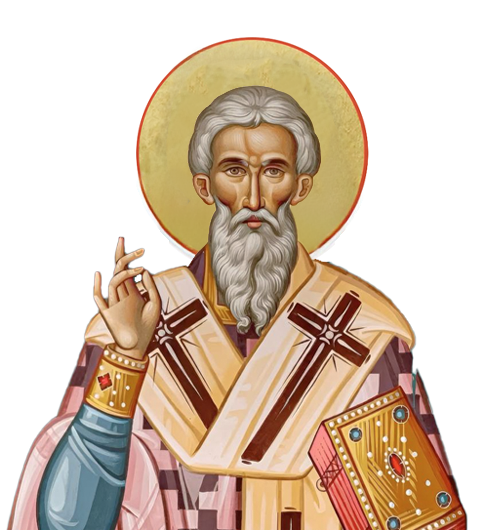
Our Holy Father among the Saints, Sophronius, Patriarch of Jerusalem – 7th Century AD
Sophronius, whose name means “chastity,” was born in Damascus to pious and chaste parents, Palentus and Myra.
This was around the year 550 AD. Sophronius possessed great intellectual abilities and a remarkable poetic talent. He combined wisdom and chastity and mastered philosophy, earning him the title “the Wise.”
Desiring to acquire spiritual wisdom, he visited monasteries and hermitages and traveled to Jerusalem.
During his visits to the monasteries scattered around the city, he happened upon the Circassian Monastery of Saint Theodosius. There he met a monk named John, nicknamed “Moskes,” a virtuous and highly learned priest with captivating spiritual wisdom. Sophronius attached himself to him wholeheartedly, without reservation, like a son to his father or a disciple to his teacher. John was also from Damascus. From then on, Sophronius followed him everywhere, coming and going, to monasteries and hermitages, to visit the holy fathers, learn from them, and gather accounts of their lives.
Both of them worked together to compile the material for the book known as “Leimon” (or in Greek, “Leimon”), which received the blessing of the Seventh Ecumenical Council. John called Sophronius “the Wise” in the book. His esteem for him went so far as to consider him a father.
He regarded him not as a disciple, but as a friend, companion, and peer, and as someone whose life was worthy of emulation. Sophronius lived with John for a time before he himself became a monk.
He became attached to him in Palestine, at the Monastery of Saint Theodosius, in the Jordanian desert, and at what is known as the “New Monastery” founded by Saint Sabas.
But the two friends left Palestine for Antioch the Great after a while, shortly before the Persian invasion. There they moved like bees from flower to flower among the Fathers, the “philosophers of the Holy Spirit,” gathering spiritual wisdom.
When the Persian armies approached the province of Antioch, the two friends left and traveled by sea to Alexandria to continue their mission.
Upon his arrival in Alexandria, he had not yet received the monastic habit. It is recorded in the book “Al-Marj” that Sophronius and John went to a wise elder of Egyptian origin and expressed their desire to live as monks together. They asked him for advice, and he replied, “You will do well to forsake the world for the salvation of your souls, my sons. Live in the quiet of your cells, observe your thoughts, and pray without ceasing. Trust in God, and He will grant you knowledge of Him and enlighten your minds.”
It is said that John made Sophronius a monk after he fell ill with an illness from which he did not expect to recover. But, by the grace of God, our saint recovered and, from then on, strove even more fervently for the salvation of himself and others.
At that time, the Monophysite heresy was gaining momentum and spreading throughout Egypt. It seems that Sophronius and John played a prominent role in opposing this heresy. Patriarch John the Merciful loved them dearly and held them in high esteem.
It is said that every Wednesday and Friday, the Patriarch would sit at the entrance of the church, giving anyone the opportunity to come and present their case. He would strive to establish peace between those who were quarreling and to seek justice for the oppressed, using all the authority and resources at his disposal.
However, one day, as was his custom, he sat down, but no one came to him. He became sad and returned home weeping, saying, “Today, lowly John has found nothing to offer, nor has he presented anything to God in atonement for his sins.” Sophronius simply replied, “Rather, Father, you should rejoice and be glad today, for your flock lives in peace, without strife or discord, like the angels of God.”
Sophronius and John Moscos, in Egypt, were like disciples striving daily to learn more about the ascents of spiritual life and divine wisdom. One story tells of their journey in this regard. They went one day to a place called Tetraphylos. There they met three blind men and sat near them, each with books they wished to read.
But their attention was suddenly drawn to the conversation taking place among the blind men. One of them asked his companion, “Tell me, my friend, how did you become blind?” The other replied, “In my youth, I was a sea captain. When we sailed from Africa, I was constantly looking out at the water, which caused me to develop glaucoma. This progressed until I lost my sight.”
The second man continued the conversation, asking his companion, “And how did you lose your sight?” The other answered, “I worked in a glass factory. One day, while I was making glass, I was distracted and burned myself. The flames from the molten glass caused me to lose my sight.”
Then the two blind men asked the third how he had become blind. He replied: “When I was young, I hated work and exertion. I found idleness more suited to me than work. When I became distressed and in need, I began to steal and commit every vice. One day, I saw the funeral procession of a rich man, and the mourners were on their way to bury him. He was dressed in fine clothes. I followed the procession until it reached the Church of St. John. There, the burial took place. When night fell, the tomb was opened, and the body was stripped of its clothes, except for its undershirt. As I was about to leave, I heard, within myself, wicked words telling me: ‘Go back and take the undershirt too, for it is of the finest quality!’ So I went back to take the undershirt as well, leaving the body naked. Suddenly, the body rose up, and its owner sat facing me. I was stunned. Then he reached out and scratched my face with his fingernails, and both my eyes went out. So, I, the accursed one, fled from the grave in terror, blind.”
When Sophronius heard this, he said to John, “Truly, Father John, we need not learn anything more today. What we have learned is of great benefit: that whoever does evil cannot escape God’s presence!”
“Preserving the faith as we received it from the Apostles, who received it from the Lord Jesus himself, is a trust upon our shoulders and a deposit for all generations to come after us.” It is to Sophronius that we owe the record of the miracle-working saints, Cyrus and John, who healed him of an eye ailment.
John and Sophronius stayed in Alexandria for several years. When the Persians threatened the city, they left for Constantinople. John the Merciful went with them, but his Lord called him to Himself on the way, and he was buried in his hometown of Amathus in Cyprus.
John and Sophronius then traveled to Rome. There John reposed, advanced in years. His friend and disciple, Sophronius, transferred his relics, according to his will, to the monastery of Saint Theodosius in Palestine, where he had originally taken his vows after it proved impossible to transfer them to Sinai as he had requested.
Sophronius as Patriarch
Sophronius and a group of his disciples, twelve in number, remained in Jerusalem. The city was still in Persian hands. Its patriarch, Zacharias, was still in captivity, as was the True Cross. Modestus was governing the Church in his absence. It wasn’t long before the True Cross and Patriarch Zacharias were returned to Jerusalem together after Emperor Heraclius achieved victories over the Persians and imposed his terms of peace upon them. The Cross had remained in Persian hands for fourteen years at that time. Zacharias did not remain on his see for long, for he reposed, and Modestus was chosen in his place. Modestus also died two years later, and Sophronius succeeded him.
The Sixth Ecumenical Council
At that time, the Monothelitism heresy emerged, which asserted two natures in Christ Jesus, but with one will and one act.
Among the most prominent proponents of this new heresy were Cyrus, Patriarch of Alexandria, Sergius, and his successor Pyrrhus of Constantinople.
Sophronius, for his part, opposed the new teaching and called for a local synod that condemned the emerging heresy.
The acts and decrees of this synod were read and blessed by the Fathers of the Sixth Ecumenical Council.
This is what he wrote later.
His Writings
In addition, Saint Sophronius had several articles, didactic writings, and hymns that demonstrate his poetic and musical talents. The Idiomile, for example, is attributed to him. Among his works are the hymn “The Voice of the Lord upon the Waters…” which is sung during the Great Hours of the Feast of the Epiphany, and the hymn “The Leaders of the Nations Gathered Against the Lord…” which is sung on Holy Thursday.
Sophronius also composed many biographies of saints, such as the life of Saint Mary of Egypt. He shepherded his flock with the fear of God and firmly and resolutely silenced the heretics.
Then came the Arab-Islamic conquest, and Jerusalem was besieged for two years. Following this, Sophronius negotiated with Caliph Umar ibn al-Khattab, who granted him protection for the Christians and their places of worship, and the city gates were opened. This occurred in the year 638 AD.
The saint did not live much longer after that, for the Lord God chose him to be with Himself. That was, it is thought, around the year 639 AD.