


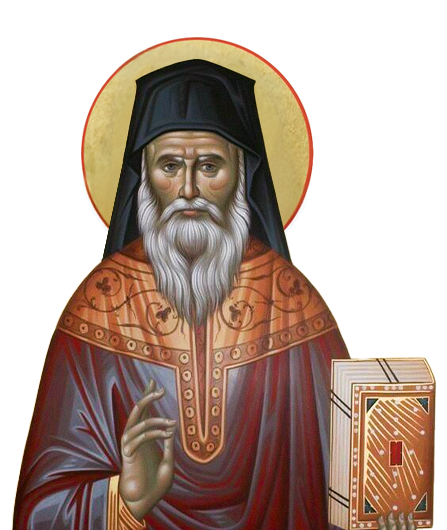
Saint Porphyrios the Seer (1906-1991):
Saint Porphyrios was born on February 7, 1906, in the village of Saint John Karistia, near Aliveri, in the province of Evia. His parents were poor but devout farmers. His father’s name was Leonidas Peraktaris and his mother’s name was Heleni. At his baptism, Saint Porphyrios was given the name Evangelos. He was the fourth of five children, but his eldest sister died young. His father desired a monastic life, but he did not become a monk. Instead, he married and sang in the church. However, poverty forced Leonidas to emigrate to the United States, where he worked on the construction of the Panama Canal.
His Childhood:
Evangelos tried to get some education at the village school, but he left after a year because the teacher was often absent due to illness, and the children were not learning much. At the age of eight, Evangelos began working on the family farm, which allowed him to read the book “St. John the Cottage Man” by spelling out the words while tending sheep in the mountains. From then on, he was consumed with a burning desire to leave and become a monk, even though he knew nothing about monastic life.
His father had taught him the Paraklesis to the Mother of God and everything related to the faith as best he could. The boy grew quickly and seemed older than his years. From a young age, he was serious, energetic, and persevering.
Despite his young age, Evangelos worked in a coal mine and from there moved to a grocery store in Chalkida, near Paros, where two other boys already worked and had agreed to share the work. However, when Evangelos arrived, they entrusted him with all the tasks, which he accepted and completed joyfully, without any malice towards them.
One day, while sweeping the storeroom, he found some green coffee beans lying around. He bent down, gathered them in his palm, and put them in a coffee bag. The shop owner, sitting in his glass-enclosed office, saw him, called him over, and congratulated him in front of the other two boys. From then on, he instructed them to divide the work amongst themselves. Evangelos’s master liked him very much and often invited him to his home.
Two years later, he moved to another grocery store owned by a relative in Berea, which had a corner restaurant. Two old men came to eat there and talked about Mount Athos. One of them had gone to the mountain to become a hermit but had returned full of regret. After they left, Evangelos became enthusiastic about the idea of going to Mount Athos and emulating Saint John the Hermit. Two days later, the old man who had gone to Mount Athos returned, and Evangelos asked him about the place, but the old man didn’t answer and left. The old man returned later and secretly told him about the mountain, explaining everything.
The Journey to the Holy Mountain:
The young Evangelos’s heart burned with love for his God, and he longed with all his being to become a hermit on the mountain. But how? And what would he say? This caused him a deep sadness that was evident in his appearance. The grocer noticed his distress and asked him the reason. Evangelos told him that he had learned his mother was ill and he wanted to go and see her. His master gave him money to buy a ticket and food for his mother and bid him farewell. The young man hurried to the mountain, but he didn’t dare go further, as conflicting thoughts tossed his mind: he was afraid and worried about his family, and he couldn’t bear it… When the boat reached Lake Evia, he disembarked and returned to Piraeus. He went to his old job and lied again to his masters, claiming that his mother was well. And so he resumed his work. Evangelos began to pray fervently, fast, and prostrate himself until his appearance changed. Again, his masters asked him the reason for his departure and gave him money and food so he could go and visit his family.
He set off, intending to go to Mount Athos. On the way, he was overcome with deep sadness: how could he leave this world without returning, and how would his family miss him and grieve? So he didn’t continue his journey but returned to Berea. After these attempts, he made a firm decision to leave and not return, and he resolved not to disembark from the ship bound for Thessaloniki. This was the third and final time. When the ship arrived in Thessaloniki, Evangelos remained on deck all day, asking someone to bring him food. In the afternoon, monks began to board the ship… It was the first time he had seen monks wearing cassocks. A venerable old man with a long beard, carrying bags, boarded with the group. He approached Evangelos, sat on a bench, and asked him to sit beside him. Then he asked him where he was going. Evangelos told him he was going to Mount Athos to work. The elder offered to take him to Kafsoukalyvia, to his hermitage, where he lived with his brother. The boy agreed, but Mount Athos forbade the entry of young children. So the elder claimed that Evangelos was his nephew, an orphan, and that he had a duty to care for him.
The Hermitage of Saint George:
The young man arrived at the hermitage and a new life began for him: services, prayers, fasting, vigils… His spiritual father, the elder he had met on the boat, was named Panteleimon, and he lived with a brother of his named Ioannikios. In this way, young Evangelos gained two spiritual fathers. Joyfully, he entrusted himself to them. Saint Porphyrios says that during his time there, he lived in bliss. But at first, he experienced a trial: thinking of his family and their sorrow for him, and he felt a longing to return to his village. Moreover, he hadn’t confided in his elders about his thoughts, so he began to lose his appetite and become depressed. His elders asked him the reason, and when he finally revealed his thoughts, he was completely freed from the trial, and joy filled his heart once more. His only complaint was that the two elders didn’t ask too much of him. He loved them dearly, even though they were very strict. He hadn’t realized this at the time. Just as he looked at the icon of Christ with reverence, he revered them with the same awe. They didn’t assign him difficult tasks; he simply watered the garden and carved wood. After a while, the elders gave him a rosary and told him to recite the Jesus Prayer every evening. In the hermitage, he learned to read properly, reciting the Psalms, the New Testament, and the Canons. At first, they didn’t allow him to leave the hermitage, but as he grew stronger, he began to go out. When he went out, he would recite the Psalms and the New Testament so as not to let his mind wander. Sometimes he would go to the Church of St. George and devote himself to the Jesus Prayer and chanting, for he had a beautiful voice. He wouldn’t allow himself to rest while carrying supplies to the hermitage, saying to himself, “I’ll show you, you little wretch!”
He knew no laziness and showed no mercy to his body. He would sometimes walk barefoot on stony, snow-covered paths. He would sleep only a little, covered with a single blanket on the cell floor with the window open. He would perform numerous prostrations and wouldn’t allow himself to succumb to sleep. He wanted to live his entire life on the mountain as an unknown hermit. The hallmark of his ascetic struggle was his complete obedience to his two elders, even though, for his own good, they reprimanded him in various harsh ways and never once said to him, “Well done!” His obedience to them was not born of hatred, but of love. Obedience benefited him greatly, making him intelligent, alert, and strong, both in body and soul. It was obedience that qualified him for the gift of clairvoyance. Obedience demonstrates our love for Christ, and Christ loves the obedient, for He Himself was obedient even unto death, death on a cross.
One day, Elder Panteleimon summoned him and asked about his plans and whether he wished to remain with them. He replied that he would. The Elder then asked him to make a prostration and dressed him in the robe, which was so old and patched that the original fabric was no longer visible. This slightly upset him, as he had expected to receive a new robe like the other novices he saw during the feasts in the churches of the great monasteries. Five minutes passed, and it was all over. He felt joy as he remembered the hermits and their rough clothes… He was fourteen years old at the time. Two or three years later
According to Saint Porphyrios, Nikita received the Great Schema at the Great Lavra Monastery. He was visited by a heavenly fragrance he smelled on his way to the Lavra, and then a sweet aroma emanated from the relics of Saint Charalambos as he kissed them. Overwhelmed with joy, he withdrew after the vigil without speaking to any monk. He had no desire to chant as usual, nor anything else. He simply wanted to hear the voice of his God.
The Visit of Divine Grace:
One day, around 3:30 a.m., Nikita went to the Great Church, the Church of the Holy Trinity, to attend the service. He arrived early, before the bells rang. No one was inside the church. He sat in the doorway under the steps and began to pray. After a short while, the church door opened, and a tall, elderly monk, Elder Dimas*, entered. When he entered, he looked around but saw no one. He took up his rosary and began making great prostrations quickly, repeating, “Lord Jesus Christ, have mercy on me… Most Holy Theotokos, save us.” A short while later, he was involuntarily overcome with awe. He stood with his arms outstretched in the form of a cross, surrounded by divine light. At once, grace was transferred to Nikita, and he entered the state of an elder. He was deeply moved and began to weep. Saint Porphyrios says, “There are no words to express what happened to him. It was a captivity from God. These things cannot be explained at all. If I tried to explain them, I would err. No, no, they cannot be explained, not even in books, they cannot be comprehended… You must be worthy to understand them.”
From that moment, the gifts of the monk Nikita multiplied. The first manifestation of these gifts was when he saw the two elders coming from a distant path beyond the mountain. He saw them as if they were right next to him. He informed his spiritual master of the incident, who advised him not to give the matter any importance. But he became more discerning and memorized most of the canons and the entire Book of Psalms. He began to see many things and pay attention to everything. His eyes and ears were opened, and he could distinguish all kinds of animals and birds. His nose was opened, and he could smell everything and discern scents with exquisite precision. He became a new person: he made everything he saw a prayer; he saw, heard, and smelled everything by the grace of God… He was moved, humbled, and prayed. The saint describes this stage, saying, “I lived among the stars, within eternity, in heaven…”
Return to the World:
With the grace bestowed upon him, the monk Nikita continued his ascetic struggles with the same humility as before, moved by his love for his God. But the Lord God had ordained a different path for him, far from the mountain. He wanted him to be a guide for souls and a shepherd for his flock. He never considered receiving a special gift from his Lord, nor did he think of leaving the holy mountain. One rainy day, he went to collect large snails, obeying Father Ionikios, and had an accident. He survived, but the accident affected his health, as he contracted pneumonia. His superiors summoned a holy hermit knowledgeable in medicine, but it was of no use. Eventually, his parents were forced to send him out into the world to receive the necessary care to recover his health, as they had neither the necessary medicine nor food like milk and eggs. He received their blessing, and with tears and great sorrow, he left, returning to Evia.
In Evia:
The monk Nikita arrived in his village. His appearance had changed completely. He was nineteen years old, with long hair and a long beard. His father was overjoyed to see him, but his mother was ashamed and scolded him, refusing to greet him. The entire village came out, curious to meet the long-haired “hermit of Mount Athos.” Nikita didn’t want to cut his hair, so he put it in boiling water. It was ruined, fell out, and he became bald.
At first, he lived with his aunt because his mother refused to take him in. There, he began to eat well and regained his health, but he didn’t stay because he felt ashamed that he hadn’t provided anything for his family, who were now taking care of him.
He went to the Monastery of Saint Charalambos. The abbot there was delighted to see him. He soon felt better and hurried to Mount Athos. His parents were overjoyed, but he fell ill again after a few days and returned to the Monastery of Saint Charalambos. He recovered and regained his strength, then went back to Mount Athos.
He went three times and returned. On the third time, his parents told him that although they didn’t want to send him out into the world, his continued stay on Mount Athos posed a risk to his health and could lead to his death, expressing their overflowing love for him.
Thus, the monk Nikita departed Mount Athos for good. He went to the Monastery of Saint Charalambos, where everyone welcomed him, loved him, and rejoiced at his return.
As for his poor mother, who was saddened that her son had become a monk, a monk from the Hermitage of Saint Nilus sent her a letter rebuking her for her hard-heartedness, telling her that even wild beasts love their young. He wrote many beautiful but harsh words. His mother was deeply saddened and changed, becoming devoted to the Church.
When her son became a priest, she never left his side. She proudly called him “Father.” She died by his side, saying, “My son, if only I had made all my children monks! At first, I didn’t realize it; if only all my children were monks!” As a priest, the monk Nikita was given complete trust in the monastery. While working, he didn’t let his mind wander but disciplined it… He was like a girl enamored with her beloved. Despite his lung disease and illness, his mind was always with his beloved… with Christ. Metropolitan Faustina, who loved monks, greatly admired him.
One day, the Metropolitan came with the Archpriest of Sinai, Porphyrios III, and they tried to persuade Nikita to become a priest, as he was reluctant. Eventually, he was ordained and took the name Porphyrios. Two years later, he was made a spiritual father and began teaching day and night, sometimes forty-eight hours straight without rest or food. At first, he was strict in granting absolution, using the Book of Confessions of Saint Nicodemus as his guide. But with time he came to his senses and remembered a canon of St. Basil which states: “He who has the power to bind and loose, if he finds that the sinner has confessed his sins and is contrived, must reduce the length of the punishment, for the judgment is not on the duration but on the manner of punishment.”
The monk-priest Porphyrios remained a spiritual father in Evia.